
Laser Prostate Surgery
Assoc. Prof. Dr. Uygar Miçooğulları, FEBU · İzmir Urology and Andrology
How does incision-free surgery work?
Scroll down or press ▶ to watch. The laser is advanced through the natural urinary tract; no incision is made in the skin.
How big is your prostate?
Using a comparison urologists also use during examinations: move the slider to see which treatments are usually considered as the prostate grows.
Prostate size alone does not determine treatment; the severity of symptoms, urine flow rate, urine left in the bladder and the examination are assessed together.
Walnut 20–25 g
Normal adult prostate size. If there are no symptoms, no treatment is needed; regular urological check-ups are recommended after age 50.
Measure your symptoms: IPSS testMandarin 30–50 g
Mild–moderate enlargement. If symptoms are mild, lifestyle advice and monitoring; if symptoms are significant, medication is usually the first step.
Medical prostate treatmentOrange 50–80 g
Moderate–advanced enlargement. If medication does not bring enough relief, or if there are problems such as inability to urinate, recurrent infection or bladder stones, surgery is considered: transurethral resection of the prostate (TURP) or laser.
Transurethral prostate surgery (TURP)Grapefruit 80–130+ g
Advanced enlargement. Because laser prostate surgery (HoLEP / ThuFLEP) can be performed regardless of prostate size, it stands out at these sizes; most patients do not need open surgery.
Laser prostate surgeryThuFLEP (Thulium Fiber Laser Prostate Surgery)
HOLEP (Holmium Laser Prostate Surgery)
It has become the most up-to-date and popular surgical method for treating prostate enlargement in America and Europe.
It has taken its place in urology guidelines as a gold standard treatment method.
What Is Laser Prostate Surgery (ThuFLEP / HoLEP)?
Laser prostate surgery refers to minimally invasive (endoscopic) operations for benign prostatic hyperplasia, performed by entering through the urethra. Essentially it is Laser Enucleation of the Prostate, and it is named after the laser used. Today it is applied to all prostate sizes of 30 g and above, and it has been shown to be superior to other techniques especially in patients with prostates over 80 g. In these patients it has become the gold standard treatment.
The widespread use of lasers in urology has led to the development of new methods in prostate surgery. Thanks to the good results obtained, the methods that are increasingly popular and widely used today are holmium laser enucleation of the prostate (HoLEP) and thulium fiber laser enucleation of the prostate (ThuFLEP). Laser prostate treatment is a new minimally invasive surgical method that allows the entire enlarged prostate tissue to be removed. It is a prostate operation performed with a laser without open incisions, giving results similar to open surgery. These methods are accepted as the gold standard of prostate treatment in the 21st century.
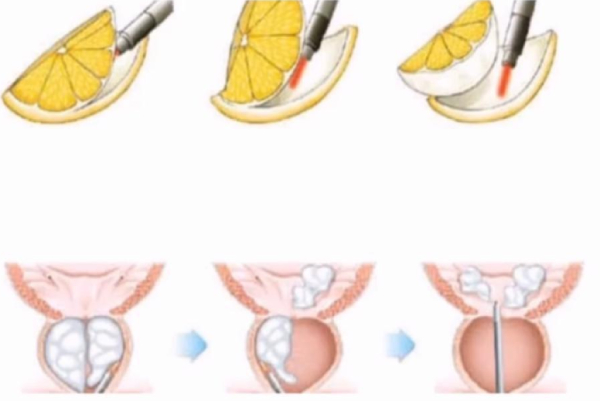
How Is ThuFLEP / HoLEP Surgery Performed?
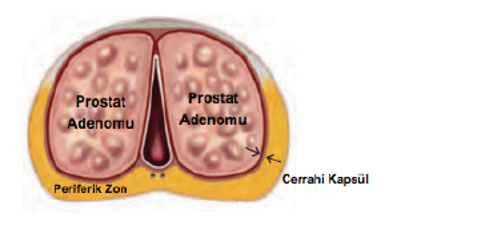
Benign prostatic hyperplasia means enlargement of the prostate tissue that surrounds the inner urinary channel (urethra). This enlarged tissue is called a prostate adenoma. Between the prostate adenoma and the outer zone of the prostate (peripheral zone) there is a capsule. This is called the surgical capsule. In operations for benign prostatic hyperplasia, the principle is to remove the prostate adenoma located inside this capsule. We call this enucleation. The prostate tissue, which is then pushed into the bladder, is broken down into small pieces with the help of a morcellator (a tissue-cutting device), much like a mincer, and removed from the body. The removed prostate fragments are sent to the pathology laboratory for pathological examination.
Who Is HoLEP / ThuFLEP Recommended For?
Laser prostate surgery is a surgical method that can be applied to anyone for whom prostate surgery is recommended. Because the laser prostate surgery technique has certain advantages over other surgical methods, it is also applied more safely in situations where other methods cannot be used.
Although the classic TUR method is not recommended for prostates larger than 80-100 g, laser prostate surgery can be applied much more successfully, especially for large prostates. In addition, there is no upper limit on prostate size for laser prostate surgery. In my own practice, I have also performed laser prostate surgery on patients with prostates of 250-300 g.
It is also applied successfully in the same session in patients who have bladder stones accompanying prostate enlargement. It is applied successfully in patients who previously had a catheter inserted because they could not urinate.
It can also be applied more safely than other techniques in patients with cardiovascular disease, those with coronary stents or a history of bypass surgery, and those taking blood thinners because of vascular blockage.
ADVANTAGES OVER OTHER TREATMENTS
- Less bleeding.
- Earlier catheter removal.
- Shorter hospital stay.
- Can be applied to large prostates.
- Allows pathological examination of the tissue.
- Faster return to daily life.
- Can be applied comfortably in people with heart and lung conditions.
- Because tissue penetration depth is low, the rate of nerve damage is low, so erections are less affected.
Is there bleeding in HoLEP surgery?
As described above, in these techniques there is no very serious bleeding while the tissue is being cut. Moreover, the somewhat larger arteries (2-3 mm) that supply the adenoma tissue can easily be sealed with laser energy. For this reason, the amount of bleeding in HoLEP surgery is quite low.
Is there urinary incontinence after laser prostate surgery (ThuFLEP / HoLEP)?
Because surgically only the prostate adenoma is removed, there is no permanent urinary incontinence after the operation. However, you may experience urinary incontinence after surgery because of other conditions you have (neurological diseases such as Parkinson's, Alzheimer's, etc.) and other urological problems (overactive bladder syndrome, etc.). You must be informed by your doctor before surgery.
Are there erection problems after laser prostate surgery (ThuFLEP / HoLEP)?
Because the nerves that produce erections run outside the prostate, patients' sexual function is not affected after these operations.
How many days does the urinary catheter stay in after laser prostate surgery (ThuFLEP / HoLEP)?
This decision may vary depending on factors such as the patient's other conditions, the use of blood-thinning medication and the weight of the prostate (in very large prostates such as 300-400 grams, it may stay in perhaps 1 more day). However, in our own practice we usually remove the catheter 2 days after the operation. Then, on the second day after the operation, once we see that the patient is urinating several times with a strong stream and without bleeding, we send him home.
Contact us for an examination and appointment
Medical Park İzmir Hospital · Appointments: 0530 574 79 89 · 444 44 84
Book an Appointment