
Testicular Cancer
Assoc. Prof. Dr. Uygar Miçooğulları, FEBU · İzmir Urology and Andrology
TESTICULAR CANCER
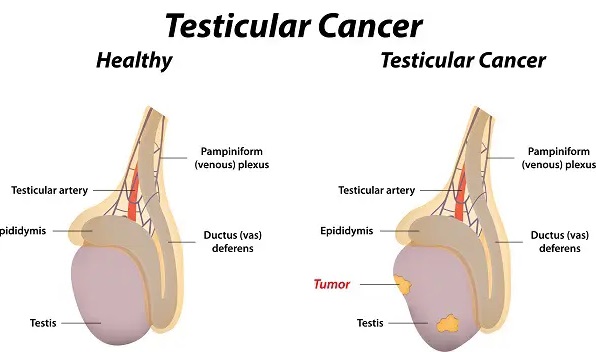
The testicles are organs whose main functions are sperm production and secretion of the male hormone (testosterone). Testicular cancer is a rare type of cancer, accounting for 1% of all cancers in men, but it is the most common solid cancer in men aged 18–35.
What Are the Symptoms?
The most common sign of testicular cancer is a painless palpable mass in the testicle. However, it should not be forgotten that some masses may cause pain. In the case of any swelling or palpable mass in the testicle, a urologist should be seen as soon as possible. For early detection of this type of cancer, men are advised to examine their own testicles once a month after a warm shower.
Apart from a palpable mass, advanced disease may lead to complaints such as back pain, bone pain, cough and changes in consciousness due to spread to distant organs, and sometimes breast enlargement and tenderness due to hormone secretion.
What Are the Risk Factors?
In patients with an undescended testicle, the likelihood of testicular cancer increases 4-8 times, even if it has been corrected surgically. A previous history of testicular cancer, testicular cancer in the family, certain genetic disorders (Klinefelter syndrome, Down syndrome, etc.), cannabis use and white race are risk factors for the development of testicular cancer.
How Is It Diagnosed?
When a palpable mass is noticed in the testicle, it is considered malignant until proven otherwise. The first and most commonly used imaging method for diagnosis is scrotal ultrasound. If a mass is detected in the testicle by ultrasound, the blood levels of certain tumor markers (βHCG, AFP, LDH) must be checked. These tumor markers are important in staging the disease and in monitoring its course afterward. In cases where advanced disease is suspected, tests such as computed tomography, bone scintigraphy and PET/CT may be required.
How Is It Treated?
Once a testicular tumor is diagnosed, surgical intervention should be performed without delay. In this operation, called inguinal orchiectomy, the testicle is removed through an incision in the groin. Further treatment and follow-up protocols are determined according to the pathology result. Some patients may require treatments such as lymph node removal surgery in a second operation (RPLND), radiotherapy or chemotherapy. In determining the treatment protocol, a joint multidisciplinary decision by the physicians of the relevant specialties (Urology, Medical Oncology and Radiation Oncology) is important for identifying the most appropriate approach.
Contact us for an examination and appointment
Medical Park İzmir Hospital · Appointments: 0530 574 79 89 · 444 44 84
Book an Appointment