
TUR (Transurethral Resection of the Prostate)
Assoc. Prof. Dr. Uygar Miçooğulları, FEBU · Urology and Andrology in İzmir
How big is your prostate?
Using a comparison urologists also use during examinations: move the slider to see which treatments are usually considered as the prostate grows.
Prostate size alone does not determine treatment; the severity of symptoms, urine flow rate, urine left in the bladder and the examination are assessed together.
Walnut 20–25 g
Normal adult prostate size. If there are no symptoms, no treatment is needed; regular urological check-ups are recommended after age 50.
Measure your symptoms: IPSS testMandarin 30–50 g
Mild–moderate enlargement. If symptoms are mild, lifestyle advice and monitoring; if symptoms are significant, medication is usually the first step.
Medical prostate treatmentOrange 50–80 g
Moderate–advanced enlargement. If medication does not bring enough relief, or if there are problems such as inability to urinate, recurrent infection or bladder stones, surgery is considered: transurethral resection of the prostate (TURP) or laser.
Transurethral prostate surgery (TURP)Grapefruit 80–130+ g
Advanced enlargement. Because laser prostate surgery (HoLEP / ThuFLEP) can be performed regardless of prostate size, it stands out at these sizes; most patients do not need open surgery.
Laser prostate surgeryTransurethral Resection of the Prostate (TURP)
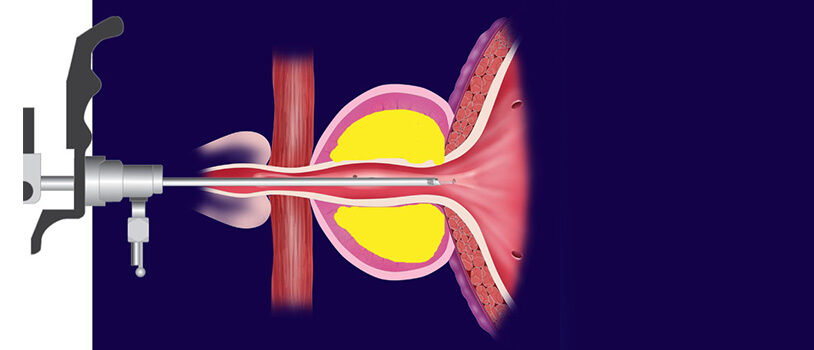
It is an endoscopic (closed) surgical method that is the most commonly performed surgical treatment for benign prostatic hyperplasia (BPH) and is accepted as the gold-standard technique for treating prostates smaller than 80 g.
In this method, after the patient is given general or spinal anesthesia, a special instrument called a resectoscope is passed through the urinary tract and the prostate tissue is cut piece by piece and removed. Various energy sources are used for this purpose. The energy source used can be monopolar or bipolar. Because no electric current passes through the patient's body in the bipolar system, it can be safely used in patients with a pacemaker. Today, the bipolar TUR system is the most preferred method in TUR operations.
While the prostate tissue is cut in strips, bleeding is stopped at the same time with the help of the device. The prostate tissue that collects in the bladder is then removed with a vacuum system. After the operation, a catheter is placed in the urinary tract and left in place for an average of 2–3 days.
Because there is no incision on the body in this procedure, recovery after surgery is fast. Many patients can get up within 6 hours, along with taking fluids and food, and can return completely to normal life the day after the operation.
Contact us for an examination and appointment
Medical Park İzmir Hospital · Appointments: 0530 574 79 89 · 444 44 84
Book an Appointment