For most patients, kidney stone pain is not just a severe attack; it is a recurring problem that affects work, sleep and freedom of movement in daily life. RIRS kidney stone surgery is one of the advanced minimally invasive surgical methods that, in suitable patients, allows stones inside the kidney to be reached through the natural urinary tract without making an incision in the body. It can be an effective option especially for stones lodged inside the kidney that are unlikely to pass on their own or that carry a risk of pain, infection or obstruction.
The decision for RIRS is not made based solely on the presence of a stone. The size of the stone, its location inside the kidney, its hardness, the number of stones, the patient's kidney anatomy, previous stone treatments and infection status are evaluated together. The aim is to clear the stone with the least possible tissue trauma and to help the patient return safely to daily life.
What is RIRS kidney stone surgery?
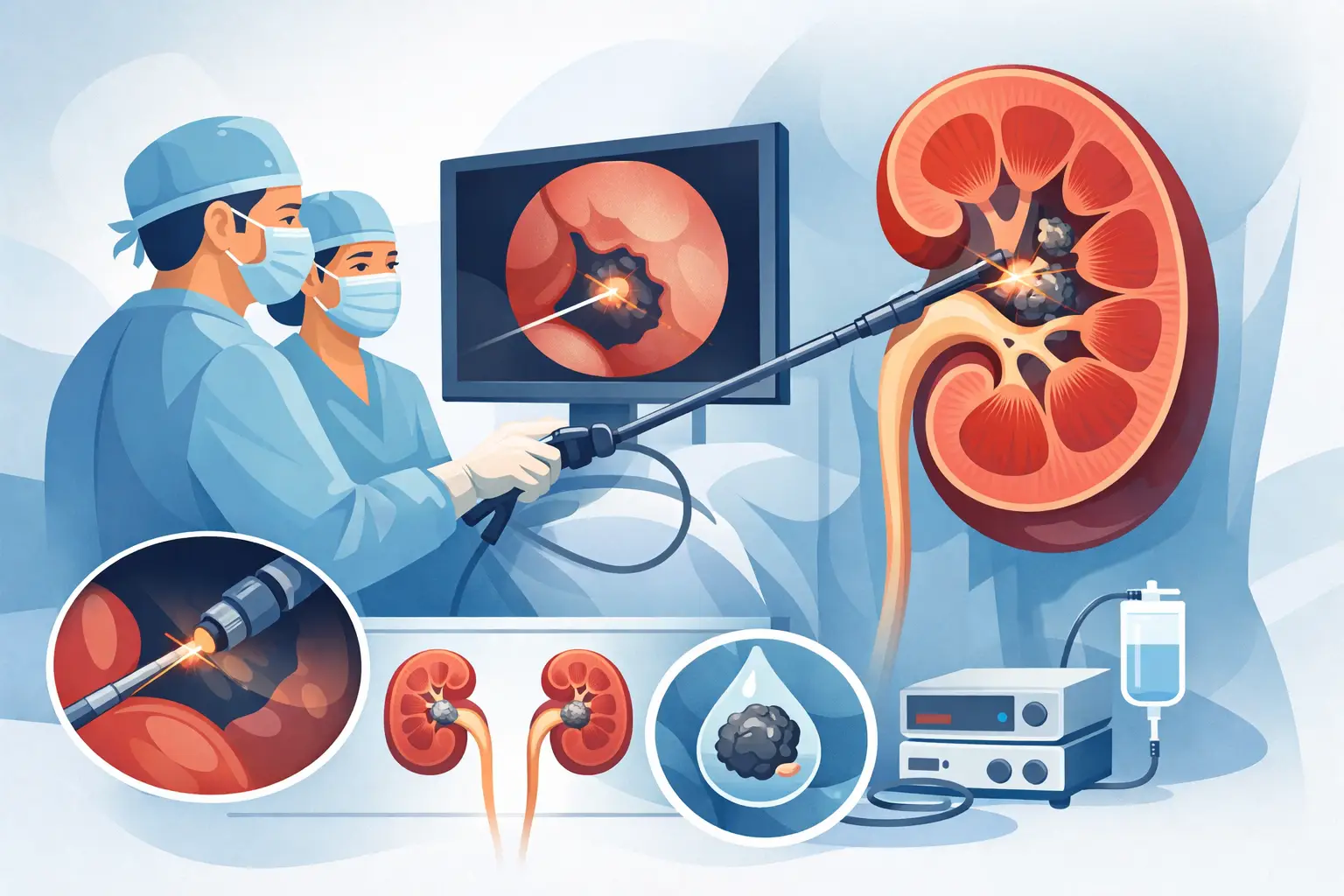
RIRS is the abbreviation of "Retrograde Intrarenal Surgery". It can be described as minimally invasive stone surgery performed in a retrograde direction into the kidney through the natural urinary tract. During the procedure, the kidney is reached via the urethra, the bladder and the urinary channel called the ureter. No incision is made in the skin.
The surgeon reaches the part of the kidney containing the stone with a flexible ureterorenoscope, a thin and flexible endoscope. Under direct vision, the stone is broken into small fragments using laser energy. Depending on the size, hardness and location of the stone within the kidney, these fragments can be removed with special instruments or reduced to a size small enough to pass naturally in the urine.
The most notable advantage of this method is that the kidney is not entered from the outside. However, RIRS is not the most appropriate approach for every stone. With a very large stone burden, complex kidney stone configurations, or in some patients where a higher stone clearance in a single session is targeted, other minimally invasive methods such as PCNL may be more suitable.
In which patients can RIRS be considered?
RIRS is considered particularly for stones located inside the kidney that cause pain, tend to grow, are associated with recurrent urinary tract infections or carry a risk of disrupting urine flow. Although it is frequently regarded as an effective option for kidney stones under 2 cm, this limit is not absolute. The calyx in which the stone sits, its degree of hardness and the kidney anatomy directly affect treatment success.
Stones in the lower calyx may require a different assessment regarding the clearance of fragments after the procedure because of the anatomical angle of the kidney. Similarly, when there are many stones or the stone is dense and hard, a single procedure may not be sufficient. Clearly explaining the possible need for a second session to the patient before the procedure is valuable for a realistic treatment plan.
RIRS should be planned individually, taking into account the use of blood-thinning medication, accompanying diseases, previous urological operations and kidney function. In particular, performing stone surgery directly while there is an active urinary tract infection may not be safe. The infection may first need to be brought under control and, if necessary, the kidney temporarily relieved with a stent or nephrostomy.
Why is the preoperative evaluation decisive?
In stone surgery, accurate imaging is the foundation for choosing the right method. Computed tomography shows the size, location and density of the stone and the structural features of the kidney in detail. Urinalysis and urine culture guide the assessment of infection, while blood tests are evaluated for kidney function and anesthesia safety.
The patient needs to share all medications they use with their physician. In particular, for aspirin, clopidogrel, warfarin and similar drugs that affect bleeding risk, planning should be done together with the specialty that prescribed the medication. These drugs should not be stopped without a physician's advice.
In the preoperative consultation, not only technical details but also the patient's expectations should be discussed. While some patients expect to be completely stone-free after a single session, a staged treatment may be more appropriate for some stones for safety reasons. Transparent information is an important part of treatment.
How is RIRS surgery performed?
RIRS kidney stone surgery is mostly performed under general anesthesia. The patient feels no pain during the procedure. The surgeon advances through the urethra to the bladder and from there to the ureter. When necessary, an access sheath may be used to protect the ureter and allow the flexible instrument to advance more safely.
Once the stone inside the kidney is visualized, it is fragmented with a holmium laser or another suitable laser technology. Laser settings are determined according to the hardness and size of the stone and the intended fragmentation method. Some stones are reduced to dust, while in some cases larger fragments are removed with special basket devices.
At the end of the procedure, a thin internal tube called a DJ stent may be placed, taking into account swelling of the ureter, the burden of stone fragments or the kidney's need for drainage. This stent supports urine flow from the kidney to the bladder. It is not mandatory in every patient; when placed, it is usually removed with a short procedure at the planned time.
The duration of surgery varies according to the number, size and location of the stones and the anatomy. The procedure is shorter for small, accessible stones, while it may take longer for multiple or difficult-to-reach stones. Safety takes priority over unnecessarily prolonging the procedure in order to remove every stone in the same session.
What is the recovery process like after RIRS?
A significant proportion of patients can be discharged after a short observation period following the procedure. However, in situations such as fever, suspected infection, significant pain, additional diseases or a more extensive procedure, hospital follow-up may be needed. Although the speed of recovery varies from person to person, the absence of an incision in this minimally invasive method generally makes the return to daily life easier.
In the first days, slight blood in the urine, burning when urinating, frequent urination or mild discomfort in the lower back may occur. These complaints may feel more pronounced in patients with a DJ stent. They are mostly temporary; however, it is important for the patient to take the prescribed medications as recommended and drink enough fluids.
In the case of symptoms such as a fever of 38 °C or higher, chills, increasing pain, foul-smelling urine, heavy bleeding, clots in the urine or inability to urinate, the physician should be contacted without delay. Signs of infection should be taken especially seriously in stone disease.
Advantages and limits of RIRS
The greatest strength of RIRS is that it can reach a kidney stone without a skin incision. In suitable patients, this approach may offer the advantages of less tissue trauma, faster recovery and an earlier return to daily life. Being able to reach different areas of the kidney with flexible instruments is also an important technical advantage.
However, the method is neither flawless nor ideal for every patient. Large stones may require more than one session. Whether the stone is cleared completely may vary depending on its location and the kidney anatomy. Infection, bleeding, ureteral injury, stent discomfort and residual stone fragments are among the possible risks. An experienced team, appropriate equipment and careful patient selection are decisive in managing these risks.
What should be done to prevent the stone from forming again?
A successful operation solves the current part of the stone problem; however, the tendency to form stones may continue. For this reason, it is useful to have the removed stone analyzed whenever possible and to perform a metabolic evaluation in patients with recurrent stones. Whether the stone is made of calcium, uric acid, cystine or another substance can change the prevention plan.
Adequate water intake spread throughout the day is a basic preventive step for most patients. In addition, it is necessary to reduce excessive salt intake, avoid uncontrolled animal protein consumption and tailor dietary recommendations to the person's stone type. Giving everyone the same diet is not right. For example, citrate supplementation may be beneficial in some patients, while others may need medication or more frequent follow-up.
A reassuring outcome in kidney stone treatment depends not only on laser technology but on accurate diagnosis, choosing the surgery appropriate for the patient and close postoperative follow-up. With a detailed evaluation by Assoc. Prof. Dr. Uygar Miçooğulları, the RIRS, URS or PCNL options suited to the characteristics of your stone can be clarified; the goal is both to treat the stone and to create a sustainable plan that reduces the risk of recurrence.