
A weak urine stream, frequently getting up at night to urinate, a feeling of incomplete emptying and recurrent urinary tract infections show the real burden of benign prostatic hyperplasia on daily life. When medication is not sufficient or the prostate volume increases, the advantages of ThuFLEP prostate surgery become one of the topics patients research most often. This method is a minimally invasive surgery that aims to remove, in a controlled way with laser energy, the part of the prostate that blocks the urinary channel.
ThuFLEP is the abbreviation of Thulium Fiber Laser Enucleation of the Prostate. The basic aim is not to remove the entire prostate, but to separate and remove the enlarged adenoma that narrows the urinary channel from the prostate capsule. In this way, the tissue obstructing urine flow is removed while the outer capsule of the prostate is preserved. In a suitable patient, this approach can be a strong option for treating large-volume prostates without the need for open surgery.
What are the advantages of ThuFLEP prostate surgery?
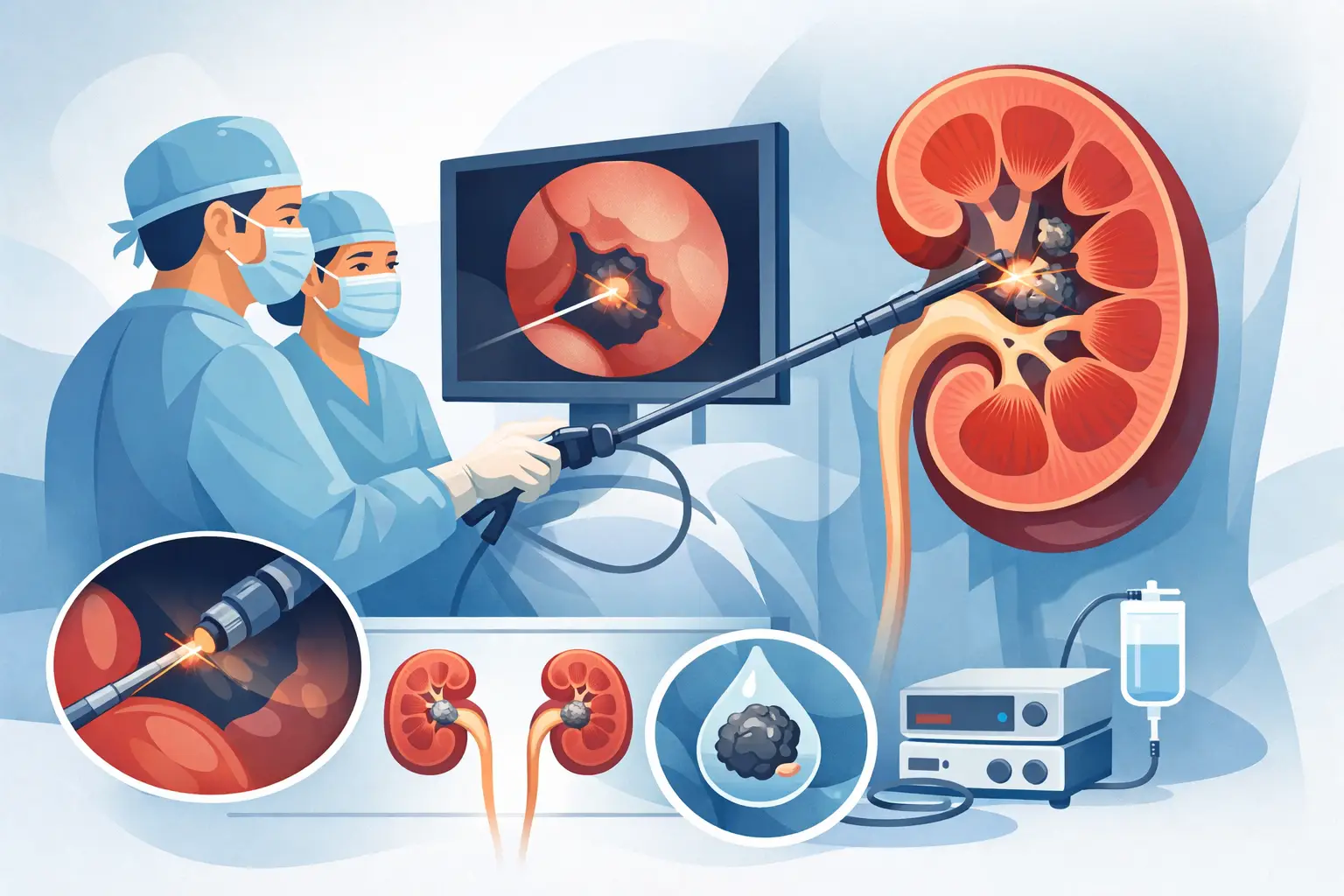
The standout feature of ThuFLEP is that it combines the laser's precise cutting and bleeding-control capacity with the enucleation technique. The surgery is performed naturally through the urethra; no incision is made in the abdomen. The enlarged prostate tissue is separated along the capsular plane, moved into the bladder and removed in small pieces with a special device.
This technique can be considered especially in patients for whom open prostate surgery or a conventional minimally invasive method has been recommended because of a large prostate volume. However, ThuFLEP is not automatically the best choice for every prostate enlargement. The size of the prostate, the structure of the median lobe, bladder function, blood thinner use, accompanying diseases, previous procedures and the patient's expectations should be evaluated together.
More effective tissue removal and the potential for long-lasting relief
In benign prostatic hyperplasia, the main cause of complaints is the adenomatous tissue pressing on the urinary channel. In ThuFLEP, the goal is to remove this tissue as completely as possible. For this reason, unlike some methods that focus only on widening the narrow part of the channel, it aims to provide a marked opening in large prostates.
Comprehensive tissue removal may have the potential to reduce the development of renewed obstruction and the need for additional procedures in the following years. Even so, no method can guarantee zero repeat procedures for everyone. The structure of the prostate, correct application of the surgical technique and postoperative follow-up are decisive for the outcome.
An important option in terms of bleeding control
The thulium fiber laser creates a controlled effect on tissue and helps coagulate small vessels during cutting. This feature can help preserve the field of view and make bleeding management easier during surgery. The method can be carefully considered especially in patients who use blood-thinning medications or have a high risk of bleeding.
However, medications are not managed in the same way in every patient who uses blood thinners. Planning may need to be done together with cardiology, internal medicine or other relevant specialties. Stopping the medication on one's own can create serious risks; surgical preparation must always be arranged according to the patient's individual medical condition.
It can be an alternative to open surgery for large prostates
In the past, open surgery was considered more often for very large prostates. With the development of laser enucleation techniques, large-volume prostates can also be treated with a minimally invasive method, in an appropriate center and with an experienced surgeon. This is meaningful because there is no abdominal incision, it reduces the need for wound care and it makes the hospital process more comfortable.
However, the term "minimally invasive" does not mean the procedure is simple. ThuFLEP is an advanced surgery that requires separating the prostate capsule and the adenoma in the correct plane, and preserving the bladder and the sphincter structures that provide urinary continence. Results are closely related not only to the technology used but also to the surgeon's enucleation experience and patient selection.
A shorter catheter time and hospital stay may be possible
After surgery, a temporary urinary catheter is used. When the catheter will be removed is determined by the size of the prostate, the course of the operation, the clearing of the urine color and the patient's general condition. Thanks to the laser's contribution to bleeding control, catheter time and hospital stay may be shorter in some patients.
Still, this period varies from person to person. The recovery plan may be different for a patient with a very large prostate, whose bladder muscle has been exposed to obstruction for a long time, or who has an additional disease. Realistic information should cover not only the advantages but also the personal variables of recovery.
What to know about sexual life and urinary continence
One of the most natural concerns of men considering surgery for prostate enlargement is sexual function. After ThuFLEP, preservation of erectile function is possible in most patients; however, age, vascular health, diabetes, blood pressure, smoking and erection quality before surgery affect the outcome. For this reason, the same sexual function outcome cannot be promised to every patient.
A more common change is retrograde ejaculation. Although the sensation of orgasm may continue, semen may flow back into the bladder instead of coming out and is then passed with urine. This condition is generally not harmful to health; however, it matters for patients who plan to have children. Discussing this expectation openly before surgery is a fundamental step in choosing the right method.
Temporary urinary incontinence may occur, especially in the first weeks. After enucleation, it may take time for the continence mechanism to adapt to the new opening. Pelvic floor exercises, regular check-ups and correct surgical technique are important in managing this process. Permanent urinary incontinence is rarer, but as with any surgical procedure, a completely zero risk cannot be claimed.
Who can be evaluated for ThuFLEP?
Patients with moderate or severe urinary symptoms that continue despite medication can be evaluated for ThuFLEP. Conditions such as recurrent urinary retention, bladder stones, recurrent infections, signs of pressure on kidney function or bleeding of prostatic origin can also strengthen the need for surgery.
The decision is not made based only on the prostate volume in the ultrasound report. Examination, PSA evaluation, urinalysis, ultrasound, a voiding test and, when necessary, additional investigations are considered together. If PSA is elevated, the possibility of cancer must first be investigated appropriately. ThuFLEP is a treatment for benign prostatic hyperplasia; it does not replace prostate cancer treatment.
What can the patient expect after surgery?
In the first days after the catheter is removed, frequent urination, a sudden sense of urgency and slightly pinkish urine may occur. These complaints, which may originate from the healing tissue, are usually temporary. For the period recommended by the physician, it is necessary to drink enough fluids, avoid heavy lifting, prevent constipation and limit activities that may increase the risk of bleeding.
In the case of fever, increasing pain, heavy bleeding with clots, complete inability to urinate or unexpected complaints, the physician should be contacted without losing time. Accessible postoperative follow-up is valuable not only for the early detection of complications but also for helping the patient manage normal signs of healing with confidence.
In the approach of Assoc. Prof. Dr. Uygar Miçooğulları, the decision for laser prostate surgery is made with a detailed evaluation and individualized planning. The aim is not only to improve urine flow, but to determine the most suitable treatment path by taking into account prostate volume, quality of life, sexual expectations, accompanying diseases and recovery conditions.
You do not have to live with prostate enlargement; however, the right solution depends not only on the newest technology but on choosing the method suited to your clinical picture. If your complaints are limiting your daily life, clarifying whether ThuFLEP is suitable for you with a detailed urological evaluation is the healthiest starting point.