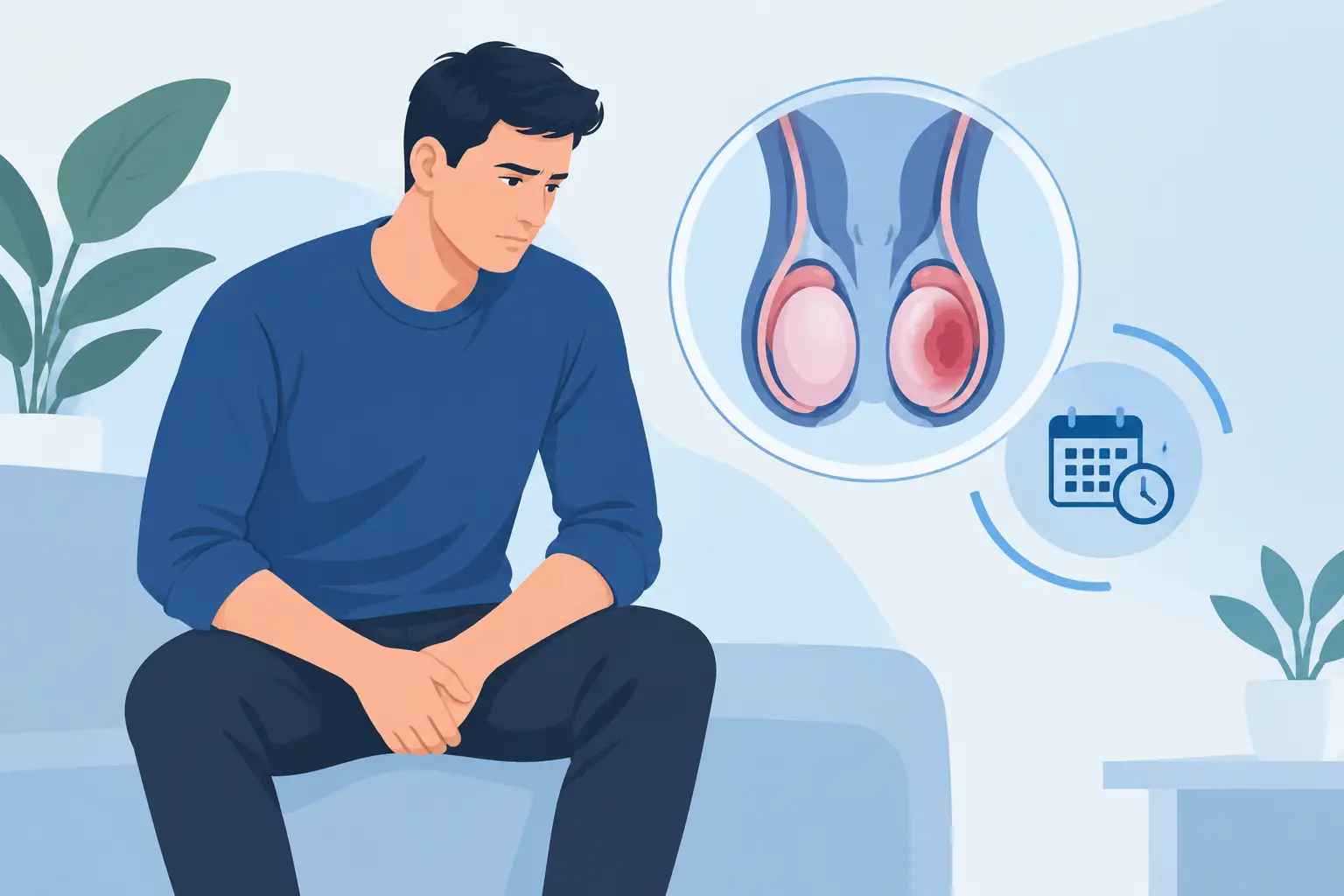
Not every hardness noticed in the testicle means cancer; however, a painless lump in particular, a change in the size of the testicle or an unusual feeling of heaviness in the scrotum should be evaluated without delay. Testicular cancer symptoms can often be mild and painless in the early stage. For this reason, the absence of pain does not mean the situation is unimportant.
Although testicular cancer is less common than some other urological cancers, it is an important disease in young and middle-aged men. Treatment success is high when it is diagnosed early. The right approach is not a self-diagnosis, but a planned evaluation carried out with an examination by an experienced urologist, scrotal ultrasound and, when necessary, blood tests.
How are testicular cancer symptoms noticed?
The most common finding is a hard, irregular and usually painless lump felt inside or on the testicle. Some people notice it in the shower or while getting dressed; others say that one testicle has become noticeably larger or harder than the other, or that its shape has changed.
The testicles do not naturally have to be exactly the same size or at the same level. One testicle hanging slightly lower is a common, normal situation. A change that raises suspicion is new and persistent enlargement, hardness, a difference in shape or fullness. Arranging a urological examination for any new finding that does not go away within a few days is the safest approach.
Other complaints that may be seen in testicular cancer include a feeling of heaviness in the scrotum, a dull discomfort in the testicle, a pulling sensation in the groin and swelling of the scrotum that does not come on suddenly. In some patients, marked enlargement of the scrotum may be seen due to fluid collecting around the testicle. These findings can also be caused by other conditions such as infection, varicocele, hydrocele or benign cysts. It is not always possible to tell them apart by examination alone; ultrasound is the guiding tool at this point.
Is pain a symptom of testicular cancer?
Testicular cancer most often presents with a painless lump. Even so, some patients may have pain or tenderness in the testicle. For this reason, interpretations such as "if there is pain, it is not cancer" or "if there is no pain, I can wait" are not correct.
Sudden, severe testicular pain, however, has a different priority. Especially if it is accompanied by nausea, vomiting, the testicle appearing pulled up or rapidly developing swelling, testicular torsion may be suspected. Torsion is an emergency in which the blood flow to the testicle is disrupted and requires evaluation within hours. In such a situation, rather than waiting for an appointment, an emergency healthcare facility should be contacted.
Pain developing together with fever, burning on urination, discharge or tenderness may point toward infection. However, even if infection is suspected, it is not right to use antibiotics or monitor the complaint yourself without an examination and the necessary tests.
What symptoms may occur outside the testicle?
When the disease reaches an advanced stage or spreads to other parts of the body, complaints that do not seem directly related to the testicle may also occur. Back or abdominal pain, unexplained weight loss, a prolonged cough, shortness of breath or swelling in the neck may rarely be evaluated in this context. However, because these symptoms can be seen in many different conditions, they do not on their own lead to a diagnosis of testicular cancer.
Some testicular tumors can cause tenderness or enlargement of breast tissue due to hormone production. This finding is uncommon, but it requires urological evaluation, especially when noticed together with a lump in the testicle. The aim is not to cause fear, but to take persistent changes in the body seriously at the right time.
Who is at higher risk?
Testicular cancer can develop in any man. However, the risk may be higher in those with a history of undescended testicle in childhood, those previously found to have a tumor in the other testicle and those with a family history of testicular cancer. Closer urological follow-up may also be needed in some men being evaluated for fertility problems.
The absence of risk factors does not provide reassurance; having risk factors does not mean cancer will definitely develop. What really matters is that a newly appearing physical change is investigated with the right methods. Awareness-focused self-checks at regular intervals can help a person get to know what is normal for them. This should not involve squeezing, pressing or checking the testicles in a way that causes pain.
What tests are done for a suspicious finding?
In the urological examination, the testicles, epididymis, groin area and abdomen are evaluated. Then, in most patients, a scrotal ultrasound is requested. Ultrasound shows whether the lump is inside or outside the testicle, whether it is solid or fluid-filled, and its blood supply characteristics. It is a painless, quick examination that does not involve radiation.
If a suspicious mass within the testicle is detected on ultrasound, certain tumor markers may be assessed in the blood. Values such as alpha-fetoprotein, beta-hCG and LDH contribute to diagnosis and treatment planning. Normal results do not definitively rule out a tumor; elevated results do not on their own establish a diagnosis. The results are interpreted together with the examination and imaging findings.
When suspicion increases, additional imaging such as computed tomography may be planned to assess the spread of the disease. The treatment approach is personalized according to the type and spread of the tumor, blood values and the patient's general condition. When necessary, the testicle may be removed surgically through the groin, a procedure known as radical orchiectomy. A direct needle biopsy of the testicular mass is generally not preferred, because diagnostic and oncological planning requires a different surgical approach.
Life after treatment, sexual health and having children
In most men, removal of one testicle does not on its own eliminate testosterone production, sexual desire, erections or the capacity to have children. Even so, the function of the remaining testicle, sperm values, any additional treatments and plans to have children are important. Especially in patients who may need chemotherapy or radiotherapy, the option of sperm freezing should be discussed before treatment.
For patients concerned about appearance, the option of a testicular prosthesis can also be considered. This decision is not mandatory and is made entirely according to personal expectations. After treatment, regular follow-up is an integral part of treatment for detecting possible recurrence early and maintaining overall health.
When should you see a urologist?
If there is newly noticed hardness or enlargement in the testicle, a marked increase in asymmetry, a persistent feeling of heaviness or unexplained swelling, a urological examination should be arranged soon. In cases of sudden and severe pain, rapidly developing swelling, nausea and vomiting, or pain that continues after trauma, urgent evaluation is needed.
Postponing a visit because of privacy concerns, embarrassment or the absence of pain is common. Yet a testicular examination takes only a short time, and when necessary, ultrasound largely clears up the uncertainty. Assoc. Prof. Dr. Uygar Miçooğulları and his team are at your service with individualized diagnostic and follow-up planning for the evaluation of suspicious testicular findings.
When you notice a persistent change in your body, getting a specialist evaluation instead of looking for the answer in internet searches both reduces anxiety and ensures that treatment, if needed, starts at the right time.