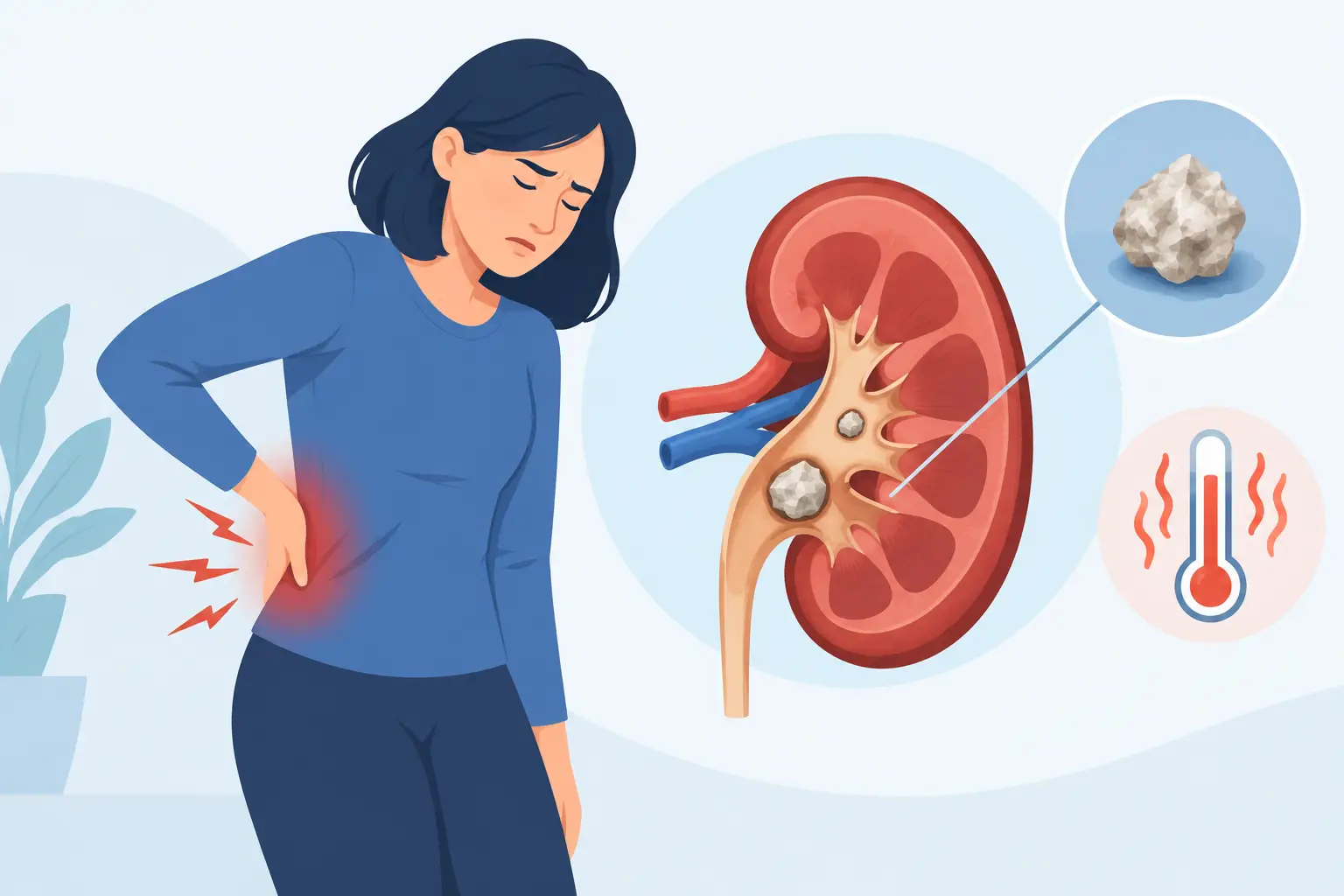
The short answer to whether a kidney stone can cause fever is this: a stone alone does not always cause fever; however, when it blocks the flow of urine and sets the stage for infection, fever, chills and a serious deterioration in general condition may be seen. This picture should not be left to wait like ordinary stone pain. Especially if severe flank pain is accompanied by fever, infected urine may be accumulating in the kidney and urgent urological evaluation is required.
Pain is common in kidney stone disease, but fever has a different meaning. Pain can occur as the stone moves within the kidney or ureter. Fever, on the other hand, is in most cases the body's response to infection. A urinary tract infection that develops together with a stone can progress, if not treated in time, to an infection that spreads to the bloodstream.
Can a kidney stone cause fever, and why?
The ureter, the channel that carries urine from the kidney to the bladder, is quite narrow. When a stone gets stuck in this channel, the passage of urine down from the kidney may become difficult or stop completely. Slowing of urine flow creates a suitable environment for bacteria to multiply. If infection is also present, pressure inside the kidney increases and infected urine may accumulate.
In this situation, fever usually rises to 38°C or above. Chills, shivering, weakness, nausea, vomiting and palpitations may accompany it. Some people also experience burning during urination, frequent urination or foul-smelling urine. However, the absence of these complaints does not rule out infection. Especially when an obstructing stone is present, flank pain and fever alone are sufficient reason to see a doctor.
The severity of the fever does not always parallel the size of the stone. A small stone can cause a serious blockage and infection, while a larger stone may cause no symptoms while it remains motionless inside the kidney. For this reason, the decision is made not only according to the size of the stone in millimeters, but according to its location, whether it causes swelling of the kidney, signs of infection and the patient's general condition.
Emergency warning signs when stone symptoms come with fever
Stone pain can at times be unbearable, but when fever accompanies it, the approach changes. If the following findings are present, emergency evaluation is needed on the same day:
- Fever above 38°C, feeling cold or marked shivering
- Being unable to keep down fluids and medication due to repeated vomiting
- Severe lower back, flank or groin pain that does not go away with rest
- A marked decrease in the amount of urine or being unable to urinate at all
- Dizziness, confusion, shortness of breath, palpitations or a feeling of markedly low blood pressure
- Pregnancy, a single kidney, kidney failure, immunosuppression or uncontrolled diabetes
With these symptoms, waiting at home for the fever to go down while using painkillers may not be safe. Painkillers can temporarily mask the complaint, while random use of antibiotics can both complicate diagnosis and delay appropriate treatment. Before the physician's evaluation, if possible, fever readings, medications used and information about previously passed stones should be noted.
Why is an infected obstructing stone an emergency?
The combination of urinary tract obstruction and infection is considered an emergency in urology. This is because the infection may remain trapped in a closed system with increased pressure. In this setting, giving oral antibiotics alone is not always sufficient. The priority is to drain the infected urine from the kidney safely and to stabilize the patient's general condition.
Depending on the patient's clinical condition, placement of a stent inside the ureter or drainage of urine by inserting a thin tube into the kidney through the skin may be planned. These procedures are different from the definitive treatment of the stone. The aim is first to eliminate the risk posed by the infection and the blockage. After the infection is under control, definitive treatment options such as minimally invasive laser surgery are considered according to the location, size and hardness of the stone.
Does every episode of stone pain involve infection?
No. Many people with kidney stones do not have a fever. As the stone moves along the ureter, it can cause severe flank pain that comes in waves, pain radiating to the groin or testicle, nausea and blood in the urine. This picture is called “renal colic” and can develop without infection.
However, the stone should not be considered completely harmless just because there is no fever. A blockage that lasts a long time can negatively affect kidney function. If the pain cannot be controlled, if urine output has decreased or if marked swelling of the kidney is detected on imaging, timely intervention may be required. The likelihood of the stone passing on its own depends on the diameter of the stone, its level in the ureter and the person's anatomical characteristics.
What tests are performed for diagnosis?
When a stone with fever is suspected, a urinalysis and urine culture are requested along with the examination. White blood cells, bacteria or blood in the urine can be informative regarding infection and stones. Blood tests evaluate markers of infection and kidney function. Especially in cases of high fever and chills, a blood culture may also be needed.
In imaging, ultrasonography can quickly show whether there is swelling of the kidney. However, for the location and size of the stone and the degree of blockage, non-contrast computed tomography provides more detailed information in most patients. The same imaging method is not used for every patient. Factors such as pregnancy, kidney function, age and clinical urgency determine the method.
How is a kidney stone with fever treated?
Depending on the patient's general condition, treatment may require monitoring in hospital. Intravenous fluid therapy, control of pain and nausea, and starting an appropriate antibiotic after culture samples have been taken are among the basic approaches. If a blockage is detected, a procedure to drain the kidney may be planned without delay.
The critical point here is that stone breaking or laser stone removal is not always the first step while the infection is ongoing. First, the infection is safely brought under control. Then, depending on the characteristics of the stone, options such as ureteroscopy and laser stone treatment, RIRS for stones inside the kidney or percutaneous nephrolithotomy (PCNL) for larger stones come into consideration. Minimally invasive methods can offer the advantages of smaller incisions, faster recovery and an early return to daily life in suitable patients; however, the most appropriate method is determined according to the stone burden and the patient.
In the evaluation performed by Assoc. Prof. Dr. Uygar Miçooğulları, the treatment plan is also personalized, based not only on the imaging result but on the risk of infection, kidney function, previous stone history and the person's living conditions.
Is stone treatment postponed after the fever goes down?
A drop in fever may not mean that the infection has completely cleared. Antibiotic treatment, the culture result and blood tests should be evaluated together by the physician. Especially if temporary drainage has been performed with a stent or nephrostomy, when these devices will be removed and when the definitive treatment of the stone will be carried out should be planned in advance.
After stone treatment, stone analysis and metabolic evaluation are also valuable. In recurrent stone disease, insufficient fluid intake, excess salt, dietary habits, urine pH and certain metabolic conditions may be investigated. The same diet is not recommended for every patient; restrictions made without knowing the chemical composition of the stone may be unnecessary or insufficient.
Does drinking plenty of water while having a fever help pass the stone?
Adequate fluid intake is beneficial in reducing stone formation; however, when fever, vomiting and blockage are suspected, forcing yourself to drink large amounts of water is not a substitute for treatment. If there is vomiting, fluid loss may develop and intravenous support may be needed. The priority is to evaluate the infection and the blockage.
Should I use antibiotics while passing a stone?
Antibiotics should only be used after a physician's evaluation. Not every stone involves infection, and the same antibiotic is not effective in every urinary tract infection. A urine culture helps select the right medication whenever possible.
Can fever recur because of a stone?
Fever may recur as long as the stone remains in place, disrupts urine flow or the infection is not adequately treated. Recurrence of fever, the addition of chills or a worsening of general condition should be re-evaluated without waiting.
When fever appears together with flank pain, the safest approach is not to assume that this is a simple process of passing a stone. Early urological evaluation helps both to protect kidney function and to prevent the serious consequences of infection.