Choosing between ESWT or a penile prosthesis for erectile dysfunction requires more than placing two different treatments side by side and simply asking “which is better?” These methods are not used for the same patient group, at the same stage or with the same goal. The right decision is made by considering together the duration of the erection problem, the vascular status, the response to medications, accompanying conditions and the person's expectations of their sex life.
Erectile dysfunction is a condition that can directly affect men's quality of life and their relationship, but it is treatable in most cases. A detailed andrology assessment that respects privacy helps avoid unrealistic expectations while leading to the most suitable treatment.
ESWT or penile prosthesis: they are not treatments of the same step
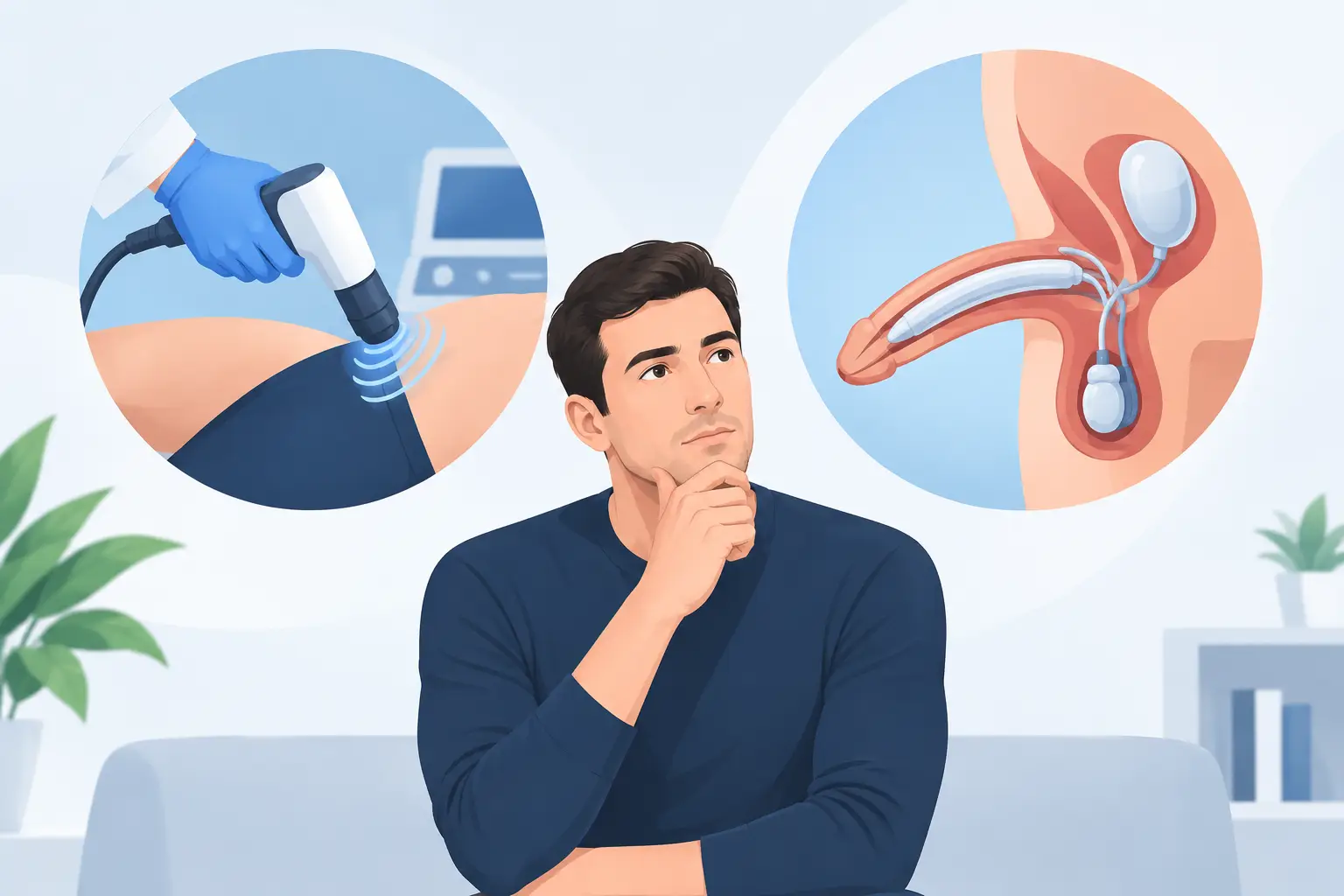
ESWT, also called low-intensity shock wave therapy, is one of the treatments that specifically targets problems with blood flow in the penis. A penile prosthesis, on the other hand, is a surgical solution considered when sufficient benefit cannot be obtained from medication, a vacuum device, injection therapy and, in suitable patients, other options.
For this reason, the treatment plan for a patient with a mild or moderate vascular erection problem who responds partially to oral erectile dysfunction medication will not be the same as for a patient with severe loss of erection who does not respond to medication and is looking for a long-term solution. ESWT aims to improve the tissue and vascular response, whereas a penile prosthesis aims to reliably provide sufficient rigidity mechanically.
Age is not the only factor that determines treatment. The duration and control of diabetes, cardiovascular disease, smoking, a history of pelvic surgery or radiotherapy, nerve damage, Peyronie's disease and psychological factors should be addressed in detail.
Who may be considered for ESWT?
Low-intensity ESWT targets dysfunction in the blood vessels that allow the penis to fill with blood during an erection. It is applied in a set number of sessions and the procedure usually does not require anesthesia. Most patients can continue their daily lives after the session.
The group for whom this method is most often considered is men with mild-to-moderate vasculogenic erectile dysfunction. Vasculogenic means that the problem arises mainly from the vascular mechanisms that supply blood flow to the penis. Especially in the early stage, some patients may benefit when it is planned together with lifestyle changes and oral medication.
However, realistic expectations are needed for ESWT. It does not have the same effect in everyone; the response may be more limited in advanced vascular disease, severe diabetes, significant nerve damage or some erection problems that develop after radical prostate surgery. The aim is not always to eliminate the need for medication completely. In some patients, the goal is to improve the response to medication or to achieve a meaningful but limited improvement in erection quality.
Why is an assessment needed before ESWT?
Erectile dysfunction can sometimes be an early warning sign of cardiovascular disease. For this reason, focusing only on the symptom is not enough. Blood sugar, blood lipids, testosterone level, blood pressure, current medications and sexual history should be reviewed. When needed, more detailed information about blood flow can be obtained with penile color Doppler ultrasonography.
In addition to showing whether ESWT is suitable, this assessment helps predict more accurately the result that can be achieved with treatment. A scientific approach does not direct every erection problem to a single device-based treatment; it builds a cause-focused, individualized plan.
When is a penile prosthesis a stronger option?
Penile prosthesis surgery is a permanent treatment for erectile dysfunction for which high patient and partner satisfaction rates are reported. It comes into consideration especially in patients who cannot achieve sufficient rigidity with oral medication, penile injections or a vacuum device, or who cannot continue these methods.
A penile prosthesis may be a more suitable option in advanced diabetes, severe vascular insufficiency, pelvic trauma, spinal cord injury, erectile dysfunction that develops after radical prostate surgery, or advanced loss of erection accompanying Peyronie's disease. The main goal here is to provide sufficient rigidity for intercourse in a predictable way that is under the person's control.
Penile prostheses basically come in malleable and inflatable models. Malleable prostheses have a simpler mechanism. Inflatable prostheses, through cylinders, a pump and a fluid reservoir, can offer a transition between flaccid and erect states that looks closer to natural. The model is chosen based on manual dexterity, anatomical features, previous operations, infection risk, expectations and the surgeon's assessment.
The balance to know about in prosthesis surgery
Penile prosthesis surgery has high satisfaction potential but is an irreversible procedure. Once a prosthesis is placed, the natural erectile tissue of the penis can no longer function as it did before. For this reason, the decision for surgery should not be made before temporary or less invasive options have been adequately considered.
As with any surgical procedure, there are risks such as infection, bleeding, pain, device malfunction and the need for revision in later years. In patients with diabetes in particular, controlling blood sugar before surgery is very important for reducing the risk of infection. Appropriate patient selection, meticulous surgical technique and close post-operative follow-up are core parts of this process.
A prosthesis does not increase sexual desire, and it has no direct therapeutic effect on orgasm or ejaculation. However, because it solves the rigidity problem, it can reduce loss of confidence and performance anxiety in sexual life. Open communication about penile length is also needed before surgery. A prosthesis aims to preserve the existing anatomical length, but people who have had erection problems for years may perceive a loss of length.
The most important criteria that shape the decision
When deciding between ESWT and a penile prosthesis, presenting a treatment as “the newest” or “the most definitive” is not the right approach. The real question is which method better suits the existing problem and the person's life.
In mild or moderate erectile dysfunction thought to be of vascular origin, ESWT may be considered together with lifestyle changes, medication and management of metabolic risks. Quitting smoking, regular exercise, weight control and management of diabetes and blood pressure also affect the success of the treatment.
On the other hand, if sufficient rigidity for intercourse cannot be achieved despite medication and injections, if treatments cannot be continued because of side effects, or if the patient wants a more lasting and reliable solution, penile prosthesis surgery is a strong option. In Peyronie's disease, when marked curvature and loss of erection occur together, reconstructive approaches and prosthesis surgery can be planned together.
Involving the partner in the process is also often helpful. When the couple understands the expectations of treatment, the recovery period and the timing of the return to sexual activity, satisfaction increases. Especially when deciding on a prosthesis, how the device is used and the temporary restrictions after surgery should be discussed in detail beforehand.
Why is follow-up after treatment part of the treatment?
With ESWT, the change achieved after the sessions is assessed at regular intervals. If necessary, medication, hormone adjustment or the lifestyle plan is updated. After penile prosthesis surgery, wound healing, signs of infection, use of the device and the timing of the return to sexual activity are closely monitored.
In the andrology approach of Assoc. Prof. Dr. Uygar Miçooğulları, erectile dysfunction is treated not just as a single complaint but as a health problem that may have vascular, hormonal, neurological and psychological dimensions. Detailed information, modern surgical options and accessible post-operative follow-up help the treatment decision to be made with confidence.
The right treatment is not the one chosen in the shortest time; it is the one that understands the cause of the problem and meets expectations realistically. If you are experiencing an erection problem, rather than putting it off, you can clarify the options that suit you through a specialist assessment that respects your privacy.