
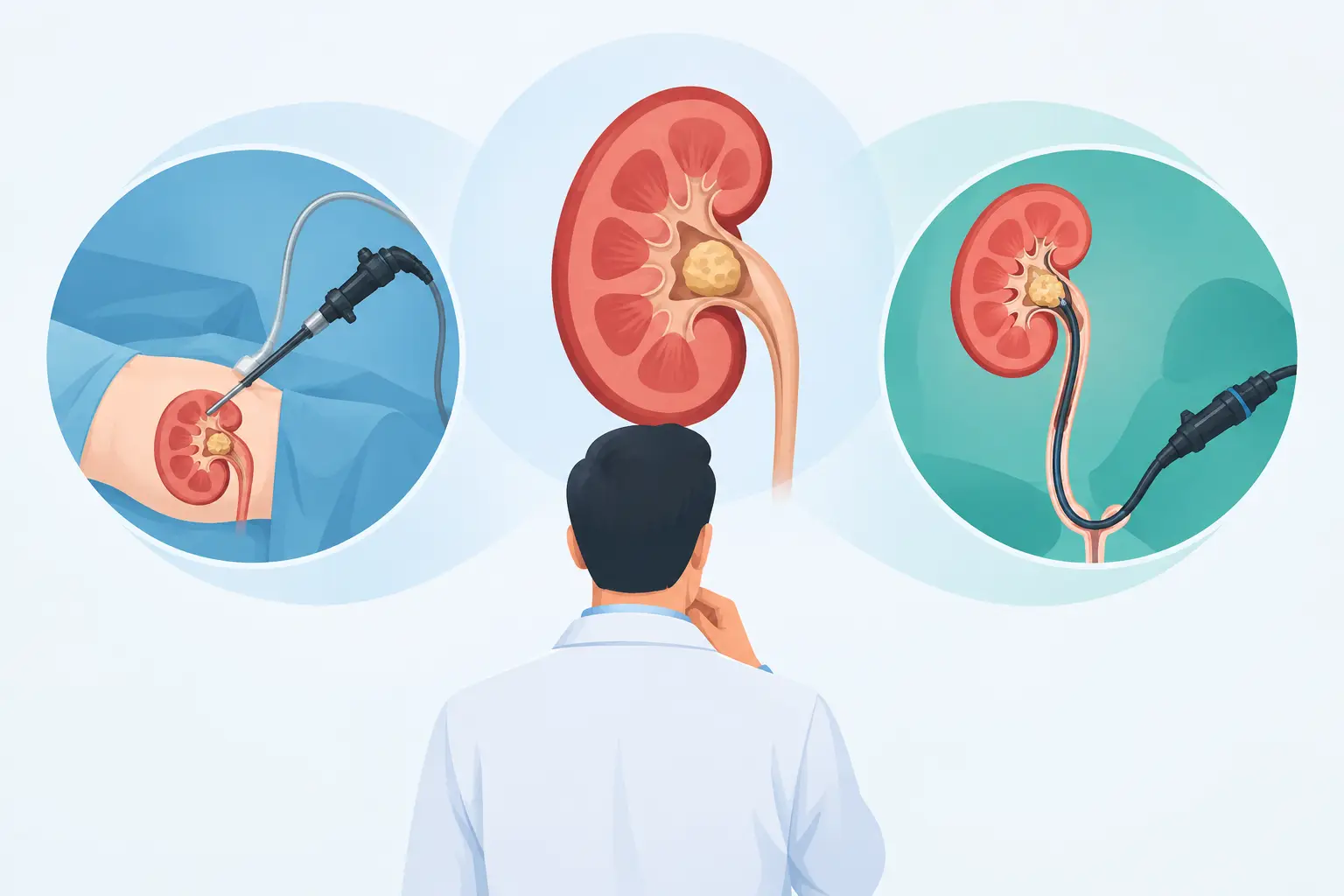
PCNL and URS are the two minimally invasive methods most commonly encountered by patients for whom surgery is planned because of a kidney stone or ureteral stone. However, although these methods may seem like alternatives to each other, they do not give the same result for every stone. The diameter of the stone, its location within the kidney, its hardness, whether it is blocking the ureter, the patient's infection status and previous procedures directly affect the treatment decision.
Choosing the right method in kidney stone treatment does not simply mean breaking or removing the stone. The aim is to clear the stone with the highest possible success, protect kidney function, manage the risk of infection and allow the patient to return safely to daily life. For this reason, CT images and the person's general health status should be evaluated together.
What are PCNL and URS?
PCNL is the minimally invasive kidney stone surgery called percutaneous nephrolithotomy. The kidney is accessed through a channel a few millimeters wide created through the skin; the stone is broken up with special instruments and the fragments are removed. It is a strong option especially for large, multiple stones or stones spread across different calyces of the kidney, as it offers a high stone-free rate.
URS stands for ureterorenoscopy. The instrument is passed through the urethra into the bladder and from there into the ureter. When the stone is reached, it is broken into small fragments with laser energy or, in suitable cases, removed. Being performed without any skin incision is one of the clear advantages of URS.
Both procedures are performed under general anesthesia. Which method is more suitable should not be decided only by looking at the size of the stone on imaging. For example, a 15 mm stone can easily be treated with URS depending on its location and the patient's anatomy, while a stone that looks smaller but is split into many fragments within the kidney may require a PCNL approach.
For which kidney stones is PCNL preferred?
PCNL mostly comes into consideration for kidney stones larger than 2 cm, for so-called staghorn stones that extensively fill the inside of the kidney, and for stones that could not be cleared despite previous treatments. With a large stone burden, the goal of clearing the stone as completely as possible in a single session is the standout feature of PCNL.
In this method, a safe access route to the kidney is created under ultrasound and X-ray guidance. The stone is visualized with a camera, fragmented with laser or mechanical energy and removed. In some patients, the access channel can be kept narrower and mini-PCNL or micro-PCNL techniques can be used. This choice is made according to the structure and location of the stone and the surgeon's safe working space.
The greatest advantage of PCNL is its effectiveness for large stones. On the other hand, because the kidney tissue is entered through the skin, risks such as bleeding, infection and injury to surrounding organs require more attention compared with URS. These risks can be reduced with an experienced team, detailed preoperative planning and appropriate patient selection; but in no surgical procedure are they reduced to zero.
In patients who use blood thinners, have uncontrolled blood pressure or have an active urinary tract infection, the PCNL plan is handled with particular care. When an active infection is detected, the priority is antibiotic treatment based on culture and safely ensuring urine drainage. Stone surgery performed before the infection is brought under control can lead to serious systemic problems.
In which situations does URS stand out?
URS is most often used to treat ureteral stones. Stones that pass into the ureter, the tube carrying urine from the kidney to the bladder, can cause severe flank pain, nausea, vomiting, blood in the urine or swelling of the kidney. Surgery may be needed for stones that do not pass despite medication, cause ongoing pain, threaten kidney function or cause obstruction together with infection.
Because the natural urinary tract is used during URS, no incision is made in the skin. The stone can be turned into dust with a laser, or larger fragments can be removed with special instruments. At the end of the procedure, a DJ stent may be placed to address temporary swelling in the ureter, the risk of narrowing, or to make it easier for small remaining fragments to pass.
A DJ stent is a thin, flexible tube that supports urine flow between the kidney and the bladder. In some patients it can cause frequent urination, mild blood in the urine, groin discomfort or pain in the kidney area. These complaints are usually temporary; however, when the stent will be removed must be clearly planned. Leaving the stent in longer than recommended can increase the risk of infection and stone formation.
How does it differ from RIRS for stones inside the kidney?
Patients sometimes hear the terms URS and RIRS together. RIRS is retrograde intrarenal surgery, in which the inner calyces of the kidney are reached with flexible instruments. Although it is technically considered part of the URS family because access is through the urethra, more flexible and thinner instruments are used to reach stones inside the kidney.
For small and medium-sized kidney stones, RIRS is a suitable option because there is no incision and recovery is usually more comfortable. On the other hand, with large or very hard stones, the procedure can take longer, a second session may be needed and the likelihood of residual stone fragments may increase. At this point, PCNL, although more invasive, can achieve greater stone clearance in a single session.
Therefore, the term “minimally invasive method” does not mean the same procedure will be applied to every patient. The right choice between URS, RIRS and PCNL requires striking a balance between post-procedure comfort and the stone-free rate.
What evaluations are made in the treatment decision?
Before stone surgery, the exact location, size and density of the stone are usually evaluated with a non-contrast computed tomography (CT) scan. Stone density can give an idea of how the stone will behave when broken with a laser. The structure of the kidney, whether the stone is in a harder-to-reach area such as the lower pole, and the skin-to-kidney distance are also details that influence the method.
Urinalysis and urine culture are among the basic tests for surgical safety. If the culture shows growth, the infection must be controlled with an appropriate antibiotic. Kidney function tests, a complete blood count and clotting parameters are also part of anesthesia and surgical planning.
In patients with a single kidney, reduced kidney function, recurrent infections or long-standing obstruction, timing becomes more critical. In such cases, a stent or nephrostomy may first be placed to relieve the kidney; definitive stone treatment can then be planned once the patient's clinical condition has stabilized.
What is the postoperative period like?
After URS, most patients can get up within a short time and return to daily life. Mild blood in the urine for a few days, burning during urination or stent-related complaints may occur. In case of high fever, increasing flank pain, chills, inability to urinate or heavy bleeding, the doctor should be contacted without delay.
The length of hospital stay after PCNL varies depending on the stone burden, the access route and the person's recovery. There may be short-term tenderness at the site where the kidney was accessed. Whether any stone fragments remain after surgery is assessed with follow-up imaging, in some patients in the early period and in others later on.
Removing the stone is not the last step of treatment. Especially for people with recurrent stone problems, stone analysis, metabolic evaluation, adjusting daily fluid intake and dietary recommendations are valuable for long-term prevention. Giving every stone patient the same diet is not correct; different stone types such as calcium oxalate, uric acid or infection stones may require different approaches.
The right surgical approach should be planned individually
The most reliable approach in choosing between PCNL and URS is a detailed urological examination that evaluates the patient's imaging and clinical findings together. In the advanced endourology approach of Assoc. Prof. Dr. Uygar Miçooğulları, the aim is to determine the most suitable minimally invasive method based on the characteristics of the stone and to support the patient after treatment with an accessible follow-up plan.
If you have a CT report or images, rather than focusing only on “how many millimeters” the stone is, ask for it to be evaluated together with where it is, how it affects urine flow and whether there are signs of infection. The right method chosen at the right time is an important step in protecting the kidney and putting the stone problem behind you more safely.