Whether penile curvature can go away on its own is one of the most common questions asked by men who notice a new bend during erection, pain, or difficulty achieving an erection. The short answer is this: some mild curvatures may remain unchanged, but waiting for a penile curvature that develops later in life to resolve completely on its own is usually not the right approach. It is not possible to make a firm prediction without evaluating the type of curvature, when it started, whether there is pain, and how it affects sexual intercourse.
Because penile curvature is an intimate subject, many men may postpone an examination. Yet early evaluation is valuable both for clarifying the cause of the curvature and for planning treatment at the right time when needed. In particular, if the curvature is progressing, if there is a noticeable feeling of penile shortening, or if it makes intercourse difficult, a urology and andrology evaluation should not be delayed.
What causes penile curvature?
A mild curvature of the penis can be a congenital anatomical feature. Curvatures that have been present since puberty and have not changed over the years are generally classified as congenital penile curvature. In this condition, the curvature is mostly noticed during erection; pain, a palpable hard plaque, or a change in shape that appears later in life are not expected.
In contrast, one of the important causes of curvature that begins in adulthood is Peyronie's disease. It develops as a result of plaque forming in the sheath called the tunica albuginea, which surrounds the erectile tissue of the penis. This plaque prevents the tissue from stretching evenly during erection, and the penis may bend upward, downward, to the right or to the left. Some patients may also experience narrowing, an hourglass appearance, loss of length, or reduced rigidity in the area of the curvature.
The exact cause of Peyronie's disease cannot be identified in every patient. Repeated minor trauma, strain during sexual intercourse, the healing response of connective tissue, genetic predisposition and certain systemic diseases may play a role. Therefore, a patient saying “I didn't have any obvious injury” does not rule out the possibility of Peyronie's disease.
Can penile curvature go away on its own?
The answer to this question depends on the type of curvature. In congenital mild curvatures that have remained the same for years, neither spontaneous improvement nor progression is generally expected. Treatment may not be necessary when the curvature does not prevent intercourse and does not cause significant discomfort. However, if the curvature makes intercourse difficult, causes pain or affects self-confidence, corrective surgical options may be considered.
In Peyronie's disease, the process is generally considered in two phases: the active phase and the stable phase. During the active phase, pain, increasing curvature or new deformities may occur. Although it varies from person to person, this phase may last for months. The pain may decrease over time; however, the disappearance of pain does not mean that the curvature has improved.
Although a limited improvement in curvature may be seen in a small number of patients with Peyronie's disease, it is not right to regard this as a reliable expectation. The curvature staying the same or progressing are among the more common courses. For this reason, the thought “let me wait a little longer, it will surely pass” may unnecessarily delay diagnosis and treatment, especially if the curvature is becoming more pronounced.
The degree of curvature alone does not determine the decision. A lower-degree curvature may make intercourse difficult for some men, while a more pronounced curvature may not cause any functional problem for another. The treatment decision should be made by evaluating the angle and direction of the curvature, changes in penile length, erection quality, difficulty during intercourse with a partner, and the patient's expectations together.
Which symptoms require seeing a doctor without waiting?
Newly developed penile curvature should always be evaluated. However, in some situations an earlier visit is particularly important. Pain during erection, a palpable hardness or plaque in the penis, a bend that increases within a short time, marked narrowing, shortening of the penis and erectile dysfunction should be investigated for Peyronie's disease.
Sudden pain during intercourse, a “cracking” sound, rapidly developing swelling and bruising, and sudden loss of erection may require emergency evaluation for penile fracture. This condition should not be confused with Peyronie's disease. Because it is a traumatic condition that may require urgent intervention, a healthcare facility should be contacted without delay.
If the curvature makes intercourse physically impossible, if pain occurs during penetration or if the erection is not sufficient, delaying a visit may place an additional burden on sexual life and psychological well-being. These problems are not without solutions; however, a detailed examination is needed to choose the right treatment.
What evaluations are performed for diagnosis?
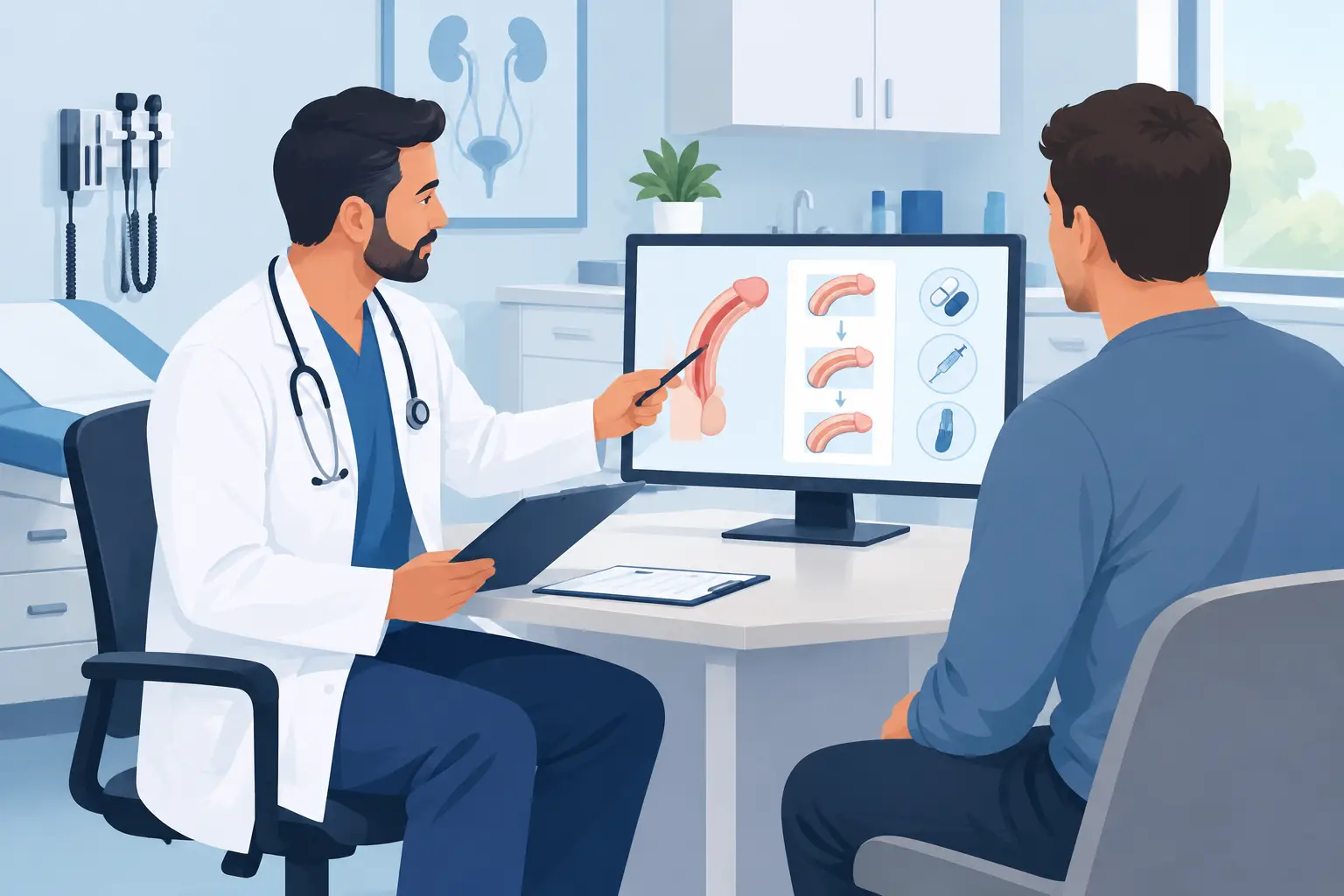
In the urology and andrology examination, the time of onset of the curvature, the rate of change, pain, previous trauma, medications used and erection quality are first asked about. During the physical examination, the presence and location of plaque on the penis is evaluated. In some patients, documenting the curvature during erection with a photograph can help assess the angle more accurately. These images should only be taken as recommended by the physician and with privacy protected.
When necessary, penile Doppler ultrasonography is used. This examination can help evaluate the structure of the plaque and the blood flow to the penis. It is particularly informative in patients with accompanying erectile problems, in those for whom surgery is planned, or when examination findings are unclear. The aim is not only to measure the curvature but to evaluate penile function as a whole.
How is treatment planned for each individual?
Not every penile curvature requires surgery. During the active phase, depending on the progression of the curvature and the pain, follow-up, oral treatments, treatments injected into the penis, or mechanical methods such as traction may be considered. The effect of these options varies from patient to patient. In particular, expecting oral supportive treatments to correct the curvature significantly in every patient is not realistic.
Penile traction devices, when used in suitable patients and for the duration recommended by the physician, may be supportive in terms of curvature and length loss. However, incorrect use, irregular use or unrealistic expectations may lead to dissatisfaction. For this reason, an individualized usage plan should be created instead of following general advice found on the internet.
Once the curvature has become stable, surgical treatment is an effective correction method when there is a significant deformity that prevents intercourse. The choice of surgery depends on the degree of curvature, penile length, plaque structure and erectile function. For shorter and limited curvatures, plication techniques may be considered. More advanced deformities may require plaque incision or grafting techniques. In patients whose erectile dysfunction does not respond to medication, a penile prosthesis may be an option that addresses both erection and curvature.
The main goal in surgical planning is not just to straighten the penis. It is necessary to preserve erectile function, discuss possible length changes in advance, clearly explain risks such as loss of sensation, and understand the patient's sexual expectations. In the andrological evaluation performed by Assoc. Prof. Dr. Uygar Miçooğulları, treatment is personalized based on these clinical details rather than directing every patient to a single method.
What should you observe before your examination?
Before seeing a doctor, it is helpful to note when the curvature was first noticed, whether it has changed in recent months, whether the pain occurs only during erection, and how it affects intercourse. Any difficulty with erections, medications used, accompanying conditions such as diabetes and previous penile injuries should also be shared. This information speeds up the diagnostic process and allows treatment options to be evaluated more accurately.
Penile curvature is not something to be ashamed of; it is a medical problem that needs to be evaluated. In the case of a newly developed or progressing change in shape, rather than waiting for it to resolve on its own, clarifying your situation with a urology-andrology examination that respects your privacy is a safer step for protecting both your sexual function and your quality of life.